Thursday, March 26, 2026
Legislative Committees Advance Building Trade’s Agenda
It’s been a busy two weeks in the California State Capitol.
The Assembly Labor & Employment committee passed:
AB 1707 (Davies – R) would require the DLSE ECU to permit the application for certification and examination as an electrician to be submitted electronically and would also permit electricians to renew their certifications electronically. The bill would permit an individual who fails the electrician certification examination to reregister for certification and to retake the examination immediately at the next available appointment with the division. Passed 7-0. WECA Supports.
AB 1838 (Berman – D) requires contractors to disclose any history of wage-and-hour violations as part of their bid submission. Contractors who fail to provide these disclosures and supporting documents may be disqualified from the bidding process. Passed 7-0. WECA Opposes
AB 1859 (Ortega – D) requires awarding bodies or owners to grant reasonable access to joint labor-management committees to ensure compliance with prevailing wage and apprenticeship standards. These committees can take legal action if access is denied. Additionally, the bill specifies that courts may impose civil penalties for violations. Passed 7-0. WECA Opposes
The Assembly Education Committee passed AB 1809 (Fong - D). This bill would make certain provisions related to job order contracting for school and community college districts permanent by removing their January 1, 2027 expiration date. Job order contracting allows these districts to hire contractors for project management through a simplified process if they have a PLA that covers all public works. Passed 7-0-1. WECA Opposes
The Senate Labor Committee passed:
SB 909 (Smallwood-Cuevas – D) would exempt contractor DIR registration fee adjustments from the APA, remove the $800 cap, and eliminate the publishing requirement. It also mandates that contractors who violate prevailing wage laws face increased penalties, with 50% of the penalties directed to the State Public Works Enforcement Fund. Passed 4-1. WECA Opposes
SB 1241 (Smallwood-Cuevas D) broadens the circumstances under which skilled and trained workforce requirements apply and includes additional changes. It prohibits the waiver of penalties if monthly compliance reports are incomplete or false. The bill also considers whether a contractor submitted and followed a compliance plan when determining penalties. Additionally, a contractor or subcontractor found guilty of material misrepresentation becomes ineligible for public works contracts. The Commissioner must investigate complaints about workforce violations from labor-management committees. Passed 4-1. WECA Opposes
—
Frying Higher
According to a report from the Economic Policy Institute, a DC-based “nonprofit, nonpartisan think tank,” California should raise the $20 minimum wage for fast-food workers to keep pace with inflation. They argue that the $20 wage — the result of a 2023 truce between fast-food companies and labor unions — has improved workers' earnings and has not caused significant job losses. Now, they write that the California Fast Food Council should prioritize a cost-of-living adjustment in 2026.

But a new study from researchers at the University of California, Santa Cruz suggests the policy may be producing unintended consequences. According to the report, while more people are applying for fast food jobs due to higher wages, many are not seeing increased hours or even securing employment at all. Researchers found that businesses are adjusting by cutting shifts, raising menu prices, and increasingly turning to automation such as self-service kiosks and mobile ordering systems. (Full disclosure, Richard is a Banana Slug)
“Based on what we’ve found, I think this legislation is a classic case of ‘no good deed goes unpunished,’” UC Santa Cruz Economics Lecturer Stephen Owen said. “There are unintended consequences and knock-on effects, and overall, I think the results have definitely not been as positive as policymakers had been expecting.”
Who do you suppose the California Fast Food Council will listen to?
—
Waters Back on Top
Rep. Maxine Waters (CA 43) has all but locked down a second turn as chair of the House Financial Services Committee if Democrats win a majority in November. That means the committee could soon have the oldest leader in its history as it grapples with technological shifts like cryptocurrency, and Democrats look to aggressively ramp up oversight of the president, his family business, and his Wall Street regulators.
Waters faces virtually no opposition, despite a growing chorus of Democrats calling for the end of Capitol Hill’s enduring gerontocracy and a long-shot Democratic challenger back in her district. Privately, some Democrats on and around the committee gripe that she doesn’t do enough to elevate her members or support them with campaign funds from the finance industry. But few are willing to publicly cross her, and she maintains the backing of most senior Democrats on the panel.
But according to the Los Angeles Times, Waters' relatives made ~$1.59 million in 2024 dollars by doing business with companies, candidates, and causes that Waters had helped. They claimed she and her husband helped a company get government bond business, and her daughter, Karen Waters, and son, Edward Waters, profited from her connections. Waters replied, "They do their business, and I do mine." Liberal watchdog group Citizens for Responsibility and Ethics in Washington named Waters to its list of corrupt members of Congress in its 2005, 2006, 2009 and 2011 reports. Citizens Against Government Waste named her the June 2009 Porker of the Month due to her intention to obtain an earmark for the Maxine Waters Employment Preparation Center.
Waters came under investigation for ethics violations and was accused by a House panel of at least one ethics violation related to her efforts to help OneUnited Bank receive federal aid. Waters' husband is a stockholder and former director of OneUnited Bank and the bank's executives were major contributors to her campaigns. In September 2008, Waters arranged meetings between U.S. Treasury Department officials and OneUnited Bank so that the bank could plead for federal cash. It had been heavily invested in Freddie Mac and Fannie Mae, and its capital was "all but wiped out" after the U.S. government took it over. The bank received $12 million in Troubled Asset Relief Program (TARP) money. The matter was investigated by the House Ethics Committee, which charged Waters with violations of the House's ethics rules in 2010. On September 21, 2012, the House Ethics Committee completed a report clearing Waters of all ethics charges after nearly three years of investigation.
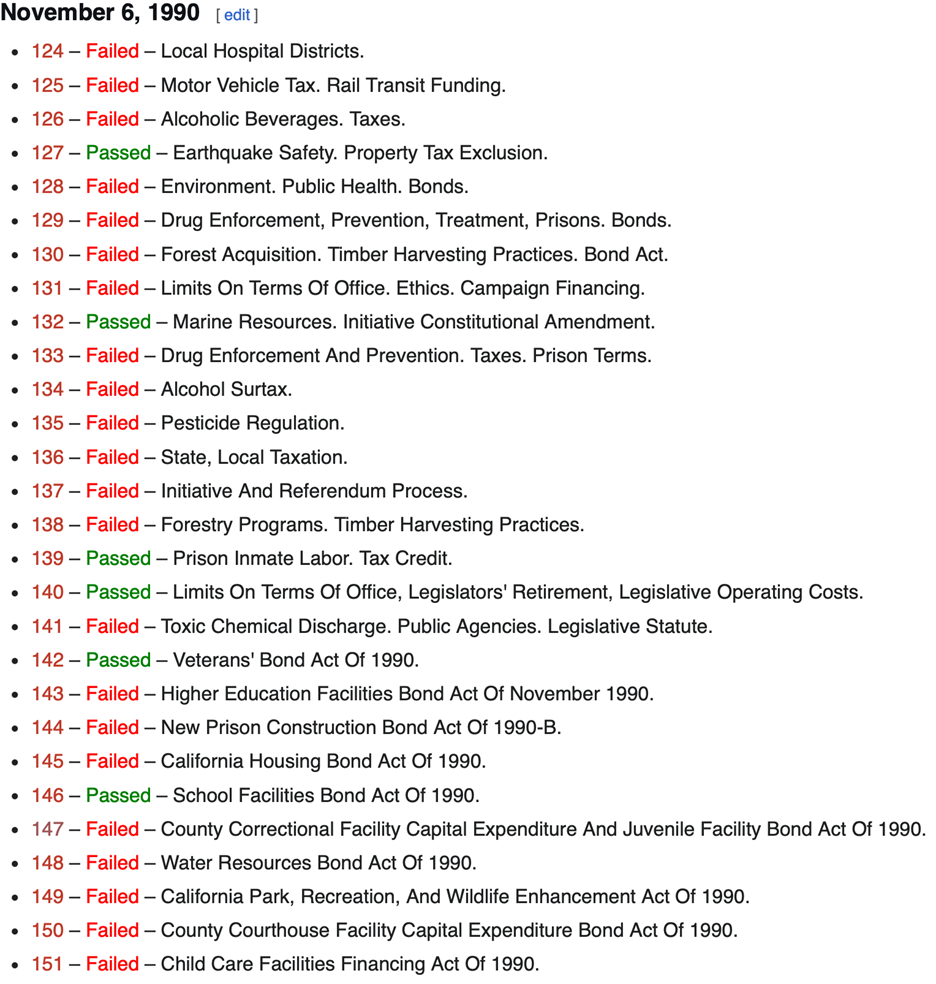
Waters had already served in the State Assembly for ten years when I arrived in 1986. My first encounter with her was in 1990 when I staffed a jail bond bill moving through the California Legislature. SB 1094, which was Proposition 147 on the November ballot. To get the bill out of the Assembly, my boss was “asked” to include $25 million to fund youth centers and youth shelters. When I took that back to my boss, the Senator from Riverside, he chuckled, “Was that from Maxine?” I said “Yes.” “Draft it,” he said, “we won’t get it out of her committee without it.”
Voters in November 1990 were tired of approving more bonds and voted “no” overwhelmingly 37% to 63%. We weren’t alone:
Voters to Decide Fate of 80 Local Tax and Bond Measures in June
In local elections across California in June, voters will consider 80 local tax and bond measures, totaling $738.5 million in direct new taxes if approved, along with additional property taxes to repay $2.6 billion in bonds, plus interest.
This total includes San Francisco’s Measure D, which would raise taxes on businesses based on the difference between executive pay and median employee wages. It does not include tax proposals that have not yet qualified for June and are moving toward the November ballot, including two major business taxes – a similar executive pay tax in Los Angeles and a separate San Francisco measure to fund a public bank by increasing gross receipts taxes on financial institutions.
After reviewing election materials from the 58 counties and consulting local election officials, CalTax found that parcel taxes make up 29 of the 80 measures. School bond measures account for 22, while 19 propose sales or transactions and use taxes, three target businesses, and four would increase transient occupancy (hotel) taxes.
Click here for the complete list of local tax measures, compiled by CalTax.
—
Only Days to Comply with New Emergency Contact Rule
Employers must provide their employees with the opportunity to designate an emergency contact and to disclose whether that emergency contact should be notified if the employee is arrested or detained under the various circumstances described in Labor Code §1555. More
—
California Lawmakers' Luxury Freebies
Trips overseas. Free spa treatments. Ritzy resort stays in Hawaii. Fancy dinners and premium seats at sporting events. These are just some of the freebies California lawmakers reported receiving last year in the mandatory reports they file with state ethics regulators. And it's all perfectly legal under California laws, despite giving powerful moneyed interest groups unfettered access to lawmakers that an average voter would never have. Story

The United States Is Adding to the National Debt Faster Than Ever
We just passed $39 trillion in national debt, only five months after we passed $38 trillion. It is not your imagination: debt is accumulating at a faster pace. Story
—
No Solar for You!
A California court ruled that regulators acted within their discretion when they established a less generous system for compensating rooftop solar owners for the power they produce, striking down a challenge from solar advocates. The California First Appellate Court issued an opinion that struck down a lawsuit the Center for Biological Diversity, Environmental Working Group and The Protect our Communities Foundation filed against the California Public Utilities Commission. The suit challenged the third-generation net metering system that the CPUC adopted in 2022 to compensate rooftop solar users less, ensuring they paid a larger share of the fixed costs of maintaining the electricity grid.
The ruling snuffed out a glimmer of hope for the rooftop solar industry, which has been fighting the less-generous so-called NEM 3.0 tariff since its adoption. Rooftop solar installations fell significantly in California after the policy went into effect. “At a time when California needs to accelerate local renewables to combat a federal obsession with fossil fuels, this is a huge step in the wrong direction,” Roger Lin, a senior attorney with the Center for Biological Diversity, said in a statement. [Politico]
—
Trump-Backed Utah Redistricting Repeal Fails to Make Ballot
A Republican-led initiative to repeal an anti-gerrymandering law in Utah will fail to make November’s ballot, despite garnering support from President Donald Trump, Turning Point Action and a host of other GOP influencers and organizations.
The ballot initiative, which sought to repeal a 2018 law that created an independent redistricting commission in the state, fell short of the required signature threshold after a coordinated signature-removal campaign, according to data released Thursday by the state election office.
The initiative’s failure, first reported by the Deseret News, is a major blow to Republicans in the deep-red state, who attempted to overturn a new judge-ordered congressional map that hands Democrats one safe blue seat. Repealing the anti-gerrymandering law would have allowed the Republican-controlled legislature to reinstall a more favorable map ahead of the 2028 elections. [Politico]
|