Thursday, April 9, 2026
Legislature Advances Dumb Bills
Stop me if you’ve heard this before, but the California Legislature likes anything the State Building and Construction Trades Council sponsors.
AB 1859 (Ortega – D) requires awarding bodies or owners to grant access to joint labor-management committees to enforce prevailing wage and apprenticeship standards. These committees can take legal action if access is denied. Additionally, the bill specifies that courts may impose civil penalties for violations. Passed Assembly Judiciary 9-3 party-line. WECA Opposes
SB 1154 (Reyes - D) gives best-value contracting option to community college districts for projects over $1,000,000. It includes bad safety language that deems any union contractor “safe” regardless of their experience. It includes STW mandates unless covered by a PLA. It mandates a report to the Legislature by January 1, 2030, on its utilization. These provisions will expire on January 1, 2031. Passed by Senate Education on a party-line 5-2 vote. WECA Opposes. Senator Rosilicie Ochoa Bogh (R-Redlands), whose husband is a subcontractor and recently visited WECA/AGC Riverside, spoke passionately in opposition to the bill’s discriminatory nature. You can watch the hearing here. SB 1154 is the first bill.
—
Washington Post Rips FLCA as Anti-Worker
On April 8, the Washington Post’s editorial board slammed the Faster Labor Contracts Act, (HR 5408), saying it would rush newly recognized unions and employers into a compressed bargaining timeline, ending in binding arbitration if no deal is reached. The board added that this could leave workers bound to a contract they never voted on and limit unions' and employers' ability to negotiate terms tailored to a specific workplace.
On March 26, Rep. Donald Norcross, D-N.J., filed a discharge petition to move the Act, which would impose mandatory arbitration on the private sector and allow the federal government to mandate terms of contracts between unions and companies.
Discharge petitions require at least 218 signatures to bypass the traditional legislative process and fast-track a bill to the floor for a full House vote. Assuming all Democrats sign the petition, Rep. Norcross would need just four Republicans to bring the FLCA for a vote. There are currently 17 Republican cosponsors on the bill!
The FLCA is a core provision of the Protecting the Right to Organize Act (PRO Act). Under this proposal, after a union organizing campaign, the parties would have less than 150 days to reach a first contract. If no agreement is reached, a government-appointed arbitrator would dictate the terms. Washington could override private-sector labor negotiations and impose contract terms on American workplaces. This would mark an extreme shift away from an economy built on voluntary agreements, worker choice, and free enterprise. [CDW]
—
Sweet Lord, Scott Wiener isn’t Progressive Enough for SEIU!
Per the San Francisco Chronicle (I know, you shake your head that I read the Chron and the New York Times)
“The California Service Employees International Union, with 750,000 members statewide, has pulled its endorsement of state Sen. Scott Wiener over his opposition to Proposition D, San Francisco’s “Overpaid CEO Act,” set to appear on the June 2 ballot. In the race to succeed Speaker Emerita Nancy Pelosi in a San Francisco House seat, the union will endorse only San Francisco Supervisor Connie Chan, who supports the tax. Previously, the union had issued a dual endorsement of Chan and Wiener. Proposition D would tax companies with more than 1,000 employees and $1 billion in annual revenue whose top executives earn more than 100 times the median pay of their San Francisco employees. SEIU locals 2015 and 1021 are sponsors of the Yes on D campaign.”
San Francisco Mayor Daniel Lurie and the city’s Chamber of Commerce oppose the tax. Wiener said he is worried the measure would slow the city’s recovery.
—
Kiley to Punish States with High Gas Taxes
California Rep. Kevin Kiley introduced a bill on Wednesday that would withhold federal transportation funding from the five states with the highest gas taxes. Kiley, a former Republican recently turned independent, announced in a post on X that he had introduced legislation to withhold annual federal transportation funding from states with gas taxes exceeding 50 cents per gallon. The move comes after Kiley warned in January that he was preparing to author the proposal, which he framed as an effort to punish California, which has the nation’s highest gas tax at nearly 71 cents per gallon. “This will stop states like California from overtaxing their residents,” Kiley wrote in his X post on Wednesday. The bill would also affect Illinois, Washington, Pennsylvania, and Indiana, which have gas taxes ranging from 54 to 66 cents per gallon. California Republicans have long blamed the state’s Democratic majority for high gas prices and have failed to advance state legislation to freeze the gas tax in recent years.
Kiley’s bill would impose an 8 percent reduction in funding on states from the National Highway Performance Program and the Surface Transportation Block Grant Program, two of the five federal highway formula grant programs.
—
Record-High Number of U.S. House Candidates Filed to Run in California After Prop 50 Mid-Decade Redistricting
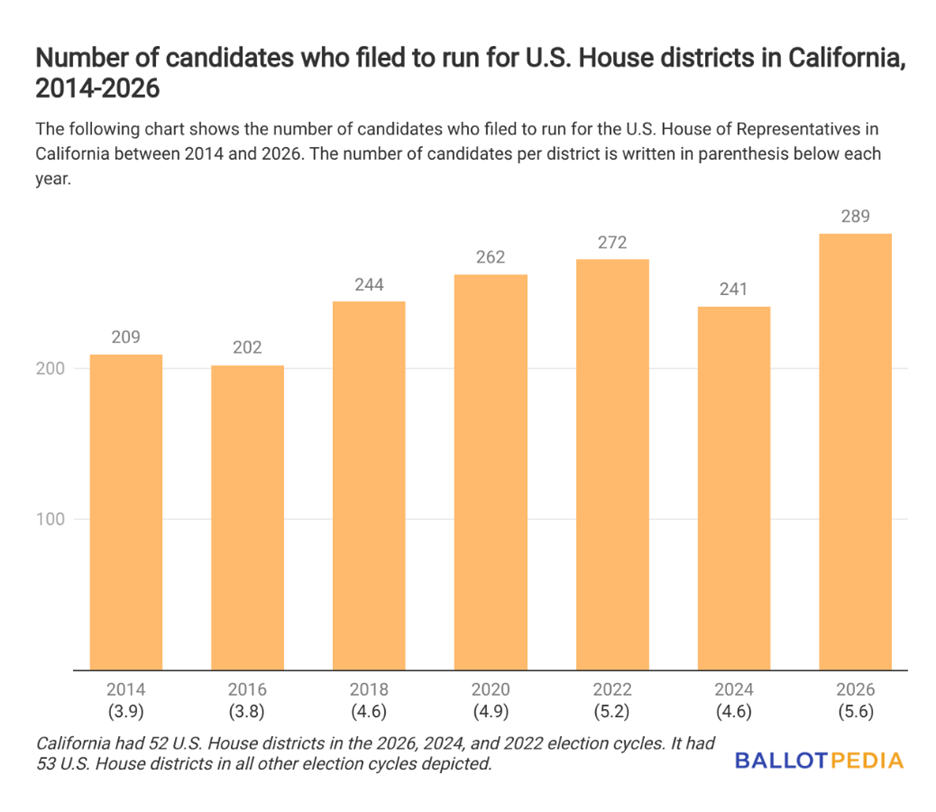
A record 289 candidates, 5.6 per district, are running for California's 52 congressional districts in the state’s June 2 top-two primaries. That’s the most candidates to run for the U.S. House since 2014 and the most candidates per district since 2022, when California was apportioned 52 districts following the 2020 census.
These primaries are happening against the backdrop of mid-decade redistricting. On Nov. 4, 2025, California voters approved Proposition 50 64.4% to 35.6%. The constitutional amendment allows the state to use a new, Legislature-drawn congressional district map for 2026 through 2030. The state’s Citizens Redistricting Commission will redraw congressional districts in 2031.
According to The New York Times’ Kellen Browning, the new congressional map makes five Republican-held districts more favorable to Democrats. As of April 6, California’s U.S. House delegation includes 43 Democrats, seven Republicans, one independent, and one vacancy.
Of the 289 candidates running, there are 154 Democrats, 97 Republicans, and 38 independent or minor party candidates. The chart below shows how the total number of candidates running and the number per district compare to recent years.
California and five other states — Iowa, Montana, New Jersey, New Mexico, and South Dakota — are holding U.S. House primaries on June 2.
Click here to learn more about California's 2026 U.S. House elections.
—
Campaign Hijinx
An opponent of Assemblymember Mike Gipson’s bid for the Board of Equalization is accusing his campaign of recruiting a candidate with a similar last name to confuse voters and split the Asian vote, according to POLITICO.
The candidate in question is Zhijing Liu, an undergraduate at the University of Southern California who will be listed on the ballot as a “banker!” Gipson’s campaign flatly denies recruiting her, and a representative told POLITICO it had never heard of her.
Yvonne Yiu, a former Monterey Park City Council member, who is running against Gipson, ties Liu to Gipson through Jose Ugarte, who used to consult for Gipson and was paid by his campaign as recently as last April, according to campaign finance records. Liu’s papers were filed by another USC student, Amir King, who has volunteered for Ugarte. But both Ugarte and Gipson’s campaigns say Ugarte, who is running for the Los Angeles City Council, had no involvement in Liu’s candidacy.
King says the explanation is simple. It was Liu’s own idea to run, and the two got connected through a mutual friend. Liu said in an email that she’s been “working at a bank and wanted to run to explore our state's tax policies to advocate for a better system. I thought the Board of Equalization was a good fit to do that,” she said. She did not respond to additional questions about the allegations, saying she needed to focus on school until finals were over.
Assemblymember Gipson has been a leader on police reform in the state Legislature for more than a decade, frequently citing his background as a Maywood police officer and publicly describing the on-duty murder of his partner.
But the Gardena Democrat has been exaggerating his brief stint as a reserve police officer — and especially his relationship with a fallen officer, John Hoglund, who was gunned down responding to a robbery in 1992.
“He’s definitely, definitely not being honest,” said former sergeant Randy Bundschuh, who was assigned to the murder investigation of Hoglund, whom friends on the force called “Hogie.” He added later in a text message: “He was NOT Hogie’s partner.”
—
CA Supreme Court Halts Bianco's Ballot Seizure
The California Supreme Court has ordered a pause in Riverside County Sheriff Chad Bianco's investigation and recount of ballots cast in the November 2025 special election as multiple lawsuits challenging the effort make their way through the courts. Bianco, a Republican and a leading candidate for governor, seized more than 1,400 boxes of ballots and other materials from local election officials earlier this year as part of the investigation, alarming voting rights advocates.
The order came in response to one of Attorney General Rob Bonta's court filings seeking to halt the investigation. Bonta, a Democrat running for reelection this year, is also seeking to stop Bianco's effort in Riverside County court. Democratic gubernatorial candidate Xavier Becerra has filed a similar, separate suit on behalf of voting rights advocates. Bianco last week said he had put the investigation on hold amid legal challenges.
Also on Wednesday, a Riverside County judge unsealed the three search warrants Bianco obtained from a different county judge — with whom Bianco has political ties — that allowed him to seize the ballots. A coalition of media outlets, including CalMatters, had asked to unseal documents, which include the sworn statements Bianco's deputies made to the judge to justify their investigation. [CalMatters]
—
Quiz: How Much Do You Know About the U.S. Tax System?
The lengthy and complex U.S. tax code can be difficult to understand. Take a quiz to see how much you really know. Quiz. (I scored 70%)
|